


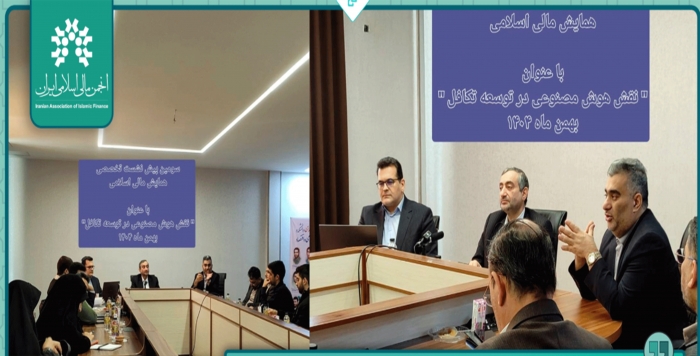
The Iranian Association of Islamic Finance convened the third pre-session of its 11th Islamic Finance Conference, focusing on the transformative role of Artificial Intelligence (AI) in developing Takaful (Islamic insurance).
The Speakers included Dr. Saeed Sehat, Faculty Member of Allameh Tabataba'i University; Dr. Abbas Rad, Faculty Member of Shahid Beheshti University and Member of the Board of Directors of Sina Insurance Company, Dr. Ehsan Jalali Lavasani, Member of the Scientific Committee of the Insurance and Takaful Business Think Tank, and Dr. Mahdi Mansouri, Head of the Takaful Specialist Center of Ma Insurance Company.
The session established that AI is a critical future driver for Takaful and Islamic finance. Dr. Sehat argued that Takaful's growth as a Sharia-compliant alternative to conventional insurance, accelerated by the need to avoid elements like riba (usury) and gambling, cannot reach optimal efficiency without targeted AI integration. This necessitates specialized human resources, data-driven management, and intelligent systems, with a future need for digital Sharia supervision.
The experts detailed AI's multifaceted applications in Takaful:
Enhancing Transparency and Justice: AI-powered big data analytics can improve risk prediction and enable fairer pricing by analyzing health, lifestyle, and environmental data, aligning with Islamic principles of justice.
Intelligent Fund Management: AI assists in predicting fund deficits/surpluses, managing cash flow, and increasing financial transparency, upholding the Islamic principle of trusteeship.
Fraud Detection and Claims Settlement: Identifying fraudulent patterns and automating claims review accelerates settlements, enhances fairness, and prevents injustice against participants.
Customer-Centric Services: AI acts as an "intelligent Takaful advisor," personalizing products (especially for micro-Takaful), educating customers, and preventing unfair sales, supporting social justice objectives.
A central challenge identified is a severe shortage of professionals skilled in both Islamic finance/Takaful jurisprudence and AI technology, a bottleneck for development in Iran and globally.
Dr. Jalali Lavasani framed Takaful's position as the pillar of risk management within the Islamic financial system. He described it as a cooperative (Ta'awun), risk-sharing model that completes the triad of Islamic finance alongside banking and capital markets (Sukuk). It replaces prohibited elements in conventional insurance—gharar (ambiguity), riba, and gambling with Sharia-compliant structures like conditional donation and ethical asset investment. AI is recreating core Takaful sectors: from pricing and governance to fraud detection and reinsurance. Complementary digital technologies like Blockchain (for immutable transparency), IoT (for usage-based models), and big data are essential for this transformation, though AI's "black box" issue demands robust ethical and regulatory frameworks.
Dr. Abbas Rad addressed the Iranian context, noting that Takaful's differentiated profit structure—where the operator earns a defined agency fee rather than retaining underwriting profits—has historically dampened insurer enthusiasm. Despite this, global Takaful growth outpaces conventional insurance, partly due to its resilience, as seen in the 2008 financial crisis. He identified transparency as a foundational pillar where Takaful and blockchain naturally converge. Highlighting a critical industry pain point, Rad cited estimates that fraud constitutes 30% of health insurance costs in Iran. AI techniques like predictive analytics, customer clustering for risk-based pricing, and association rule mining are vital tools to combat this fraud and enhance actuarial functions. He warned that technological evolution, including cryptocurrency adoption, could intensify competition from foreign insurers.
Dr. Mahdi Mansouri emphasized a philosophical and institutional perspective, stating that developing Takaful without deep understanding of hermeneutics (interpretation of legal, jurisprudential, and economic texts) is futile. He categorized insurance evolution into generations: from paper-based (1st) to digital (2nd) to smart and cognitive systems based on AI (3rd & 4th). With Iran's insurance penetration rate low (2.1%), he posited that with proper legal frameworks, Takaful could leapfrog into these advanced generations, acting as "wings" for the national economy. Crucially, he concluded that for AI to be effective in Takaful, it must transcend mere calculation; algorithms need to grasp jurisprudential concepts like gharar and cooperative participation. Therefore, "Hermeneutics is the heart of artificial intelligence in Takaful."
In conclusion, the session underscored that AI and related digital technologies are indispensable for enhancing the efficiency, transparency, accessibility, and Sharia compliance of Takaful. Successful integration in Iran hinges on overcoming key hurdles: developing cross-disciplinary human capital, establishing supportive legal and regulatory frameworks, ensuring ethical AI governance, and maintaining the essential interpretive (hermeneutic) link between Islamic law and technological systems.