


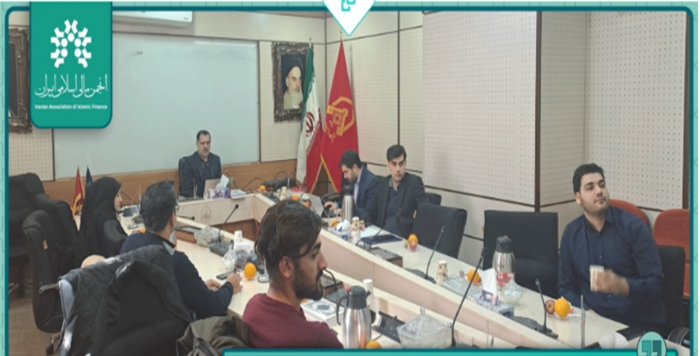
The Iranian Association of Islamic Finance (IAIF) convened the second pre-session of its 11th Islamic Finance Conference on January 28 in collaboration with Imam Hossein Comprehensive University, focusing on banking regulation and supervision in the age of Artificial Intelligence (AI). The session featured presentations from several experts who analyzed the challenges and pathways for integrating advanced technologies, particularly AI, into the supervisory frameworks of Islamic banking.
The speakers of the session were:
Dr. Taghinataj-Malekshah, Associate Professor at the University of Tehran and a board member of the National Development Fund;
Dr. Mohammad Solgi, Dean of the Faculty of Management and Strategic Planning at Imam Hossein Comprehensive University;
Dr. Vahab Gholich and Dr. Azam Ahmadian, faculty members of the Monetary and Banking Research Institute of the Central Bank;
Dr. Alireza Ramrooz, a university faculty member.
The discussions centered on the critical inadequacy of traditional supervisory models in handling modern financial systems' complexity and data volume. A core theme was the dual challenge for Islamic banks: complying with conventional regulations while simultaneously adhering to Sharia principles. This necessitates a transformative adoption of Regulatory Technology (RegTech), a FinTech subset designed to make compliance more efficient. However, significant barriers to RegTech implementation in Iran were identified, including weak data and technological infrastructure, institutional resistance to digital change, insufficient legal frameworks, and the added complexity of ensuring Sharia compliance. The experts stressed that Sharia considerations must be fundamentally integrated into all technological supervision efforts, not treated as an add-on.
A major focus was the substantial research gap in this field. Studies are often fragmented, lacking a coherent strategic framework specifically for overcoming Islamic banking obstacles in the local context. There is a pronounced disconnect between theoretical Sharia discussions and their practical, technological implementation. A key conceptual distinction was emphasized: the need to move from merely "supervising technology" to employing "supervisory technologies"—using advanced tools like AI for the act of supervision itself.
The challenges were categorized across multiple dimensions:
Structural: Outdated laws, passive supervisory approaches, and a lack of integrated systems.
Institutional: Weak coordination between banks, regulators, and Sharia bodies, insufficient institutional authority, and a brain drain of skilled professionals.
Executive: Poor data infrastructure and low-quality data, which hamper effective online supervision.
Human/Cultural: A lack of specialized AI talent, resistance to organizational change, and an underdeveloped data-driven culture. Investments in technology often fail without proper cultural adoption and training within organizations.
The speakers proposed multi-faceted solutions for transitioning to a "smart supervision" paradigm. This requires simultaneous progress in legal reform, technological investment, institutional restructuring, and human capital development. International cooperation is essential for accessing technology and knowledge. Crucially, institutional collaboration between the central bank, Sharia scholars, and tech companies is needed to integrate Sharia principles into technological design. One presentation highlighted a six-stage model for this transition, dependent on parallel advancements in regulation, technology deployment, and specialized human resources aligned with algorithmic processes.
The potential of AI was explored in detail. It can enhance justice and transparency, improve risk prediction and fraud detection, and even aid in Sharia advisory roles, as seen in countries like Malaysia. However, risks such as algorithmic bias, ethical dilemmas, and threats to privacy were also noted. The preservation of an Islamic lifestyle within a digitizing financial system requires proactive policy. A pressing need for interdisciplinary education was highlighted to build human resource expertise that blends Islamic finance, technology, and ethics.
In conclusion, the central challenge is updating legal and Sharia frameworks to enable a manually managed system to evolve using technological capacities. Success depends on strategic will and institutional reforms. A proposed practical step is for banks to proactively and voluntarily adopt regulatory technologies, fostering a competitive environment that accelerates implementation rather than waiting for top-down mandates. The path forward lies in bridging the significant gap between theoretical potential and practical, Sharia-compliant execution.