


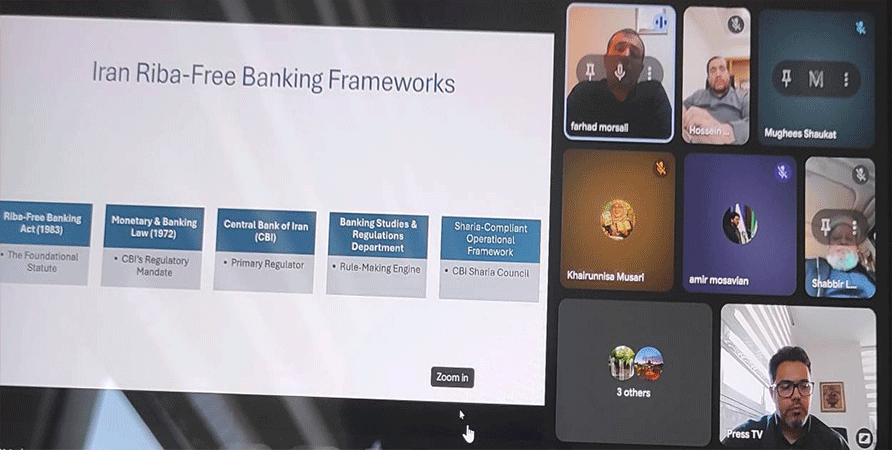
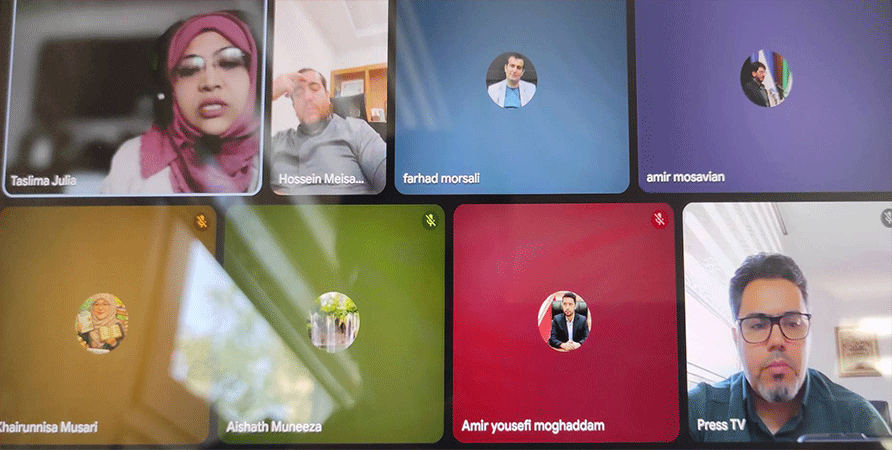
The Iranian Association of Islamic Finance held the 2nd session of the 4th edition of its international Forum Committee (IFC) on June 6.
At first, Dr. Farhad Morsali gave a lecture on Navigating Non-Performing Loans in Iran – Islamic Principles and Policy Updates, then Dr. Julia Taslima, Islamic Finance Researcher, talked about the Rise of Islamic Finance in Türkiye – Latest Developments and Future Outlook.
Dr. Farhad Morsali, IAIF’s Scholar Member
Navigating Non-Performing Loans in Iran – Islamic Principles and Policy Updates
Non-performing loans (NPLs) represent a significant challenge for Iran’s unique financial landscape, where Islamic banking is universal. Unlike conventional systems, NPLs in Iran arise from Sharia-compliant contracts such as Murabaha, Ijara, and Mudaraba, meaning that solutions cannot be imported “as is” and must adhere to principles including the prohibition of Riba (interest) and the avoidance of Gharar (excessive uncertainty). Addressing NPLs is not merely a technical issue but a critical test of the Islamic banking model itself, especially given the pressures of sanctions, inflation, and governance weaknesses.
The primary drivers of NPLs in Iran include macroeconomic shocks, directed lending, weak credit risk management, and slow legal enforcement. In response, the Central Bank of Iran (CBI) has introduced several measures: capital injections into distressed banks, forced mergers (e.g., Ayandeh Bank), shutdowns of unlicensed institutions, and publication of major debtor lists to increase transparency. Monthly NPL ratio reporting is now used to track system-wide asset quality.
However, significant policy gaps remain, including outdated provisions in the Riba-Free Banking Act (RFBA) (1983), weak collateral enforcement, and a lack of unified Sharia and accounting standards for NPL treatment. To resolve distressed assets in a Sharia-compliant manner, tools such as genuine restructuring, asset-based workouts (sale/lease-back), converting debt into Musharaka participations, and Sukuk-based securitization are being explored. Robust Sharia governance at both bank and system level is essential to align risk management with religious rulings.
Strategic Recommendations
For regulators, the priority is updating the RFBA and legal infrastructure to explicitly cover NPL recognition, insolvency, and collateral enforcement. Banks must improve early-warning systems and establish specialized NPL units with Sharia and restructuring expertise. Policymakers should encourage innovation in distressed-asset funds and adopt standards like AAOIFI.
Ultimately, NPLs are a stress test for Iran’s Islamic banking architecture. Success depends on aligning core Sharia principles with modern risk tools and credible reforms. The question is no longer whether Islamic banking can handle NPLs, but how quickly Iran can build the frameworks to do it well.
Dr. Julia Taslima, Islamic Finance Researcher
The Rise of Islamic Finance in Türkiye – Latest Developments and Future Outlook
As the global Islamic finance industry surges toward a projected $10 trillion in assets by 2030, Türkiye has emerged as a dynamic and rapidly growing hub. Currently ranking 10th globally with approximately $127 billion in total Islamic assets, the country is executing an ambitious strategy to break into the top five by the end of the decade. Driven by regulatory reforms, digital innovation, and the new Istanbul Financial Centre (IFC), Türkiye’s participation finance sector is undergoing a profound transformation.
Growth and Market Performance
Türkiye’s modern Islamic finance journey began in 1985 with the first "Special Finance Houses." After rebranding as Participation Banks in 2005, the sector has seen exponential growth. By the end of 2025, participation banking assets reached TRY 4.32 trillion (over $100 billion), marking a staggering 63% annual growth. The sector’s share of total banking assets now stands at 9.2%, serving 17.2 million customers across six Shariah-compliant banks and two new digital-only players. Notably, the non-performing financing (NPF) ratio remains low at 2%, below the sector average.
Sukuk and Capital Markets
Türkiye has solidified its position among the world’s top five sukuk issuers, alongside Saudi Arabia, Malaysia, and the UAE. The market saw landmark deals including a $750 million sovereign wealth fund sukuk in 2024 and the announcement of a $4 billion energy sukuk by state oil firm TPAO—the nation’s largest-ever Islamic issuance. Domestic lease certificates are widely used across banking and infrastructure, while a growing global trend in blockchain-based digital sukuk (approximately $1.6 billion issued globally) is gaining traction locally.
Digitalisation and Green Finance
Türkiye’s participation banks are leading in digital transformation. With two fully digital participation banks operational and more expected, mobile and online banking users have surpassed 6.6 million. GCC investors are channeling significant fintech investment into the country, signaling strong regional confidence. Furthermore, the publication of AAOIFI standards in Turkish in 2024 is standardizing Shariah compliance.
Aligning with global ESG trends, Türkiye is integrating green finance with Maqasid al-Shariah. The global ESG sukuk market grew 23% to $45.2 billion in 2024, and TPAO’s $4 billion energy sukuk aims to directly support sustainability and energy independence. The Istanbul Financial Centre (IFC) inaugurated in 2023, serves as the strategic hub for this green and participatory finance ecosystem.
Challenges and Outlook
Despite successes, Türkiye faces challenges. The 15% market share target by 2025 was not met (currently 9.2%), capital ratios face pressure, and public awareness remains below potential. However, the outlook for 2026 and beyond is highly positive. With accelerating GCC investment, new digital banks, and the IFC attracting global players, Türkiye is well-positioned to achieve its top-five global ranking by 2030.
Members:
1- Dr. Gholam Reza Mesbahi Moghadam, Head of Sahariah Council at Central Bank of Iran and Head of Shariah Committee at Securities and Exchange Organization of Iran (SEO)
2- Dr. Azmi Omar. President and CEO INCEIF, Malaysia
3- Sheikh Shabbir Hasan Maisami, Founder & Chairman, Al-Sadiq Institute of Islamic Banking, Finance & Takaful, Pakistan
4- Dr. Mohamad Akram Laldin from INCEIF, Malaysia
5- Dr. Turalay Kenç, Former Deputy Governor of Central Bank of Turkey
6- Dr. Mughees Shaukat Executive Advisor at Islamic International Rating Agency, Bahrain
7- Dr. Hossein Meysami, Head of the Secretariat of Shariah Council of the Central Bank of Iran
8- Dr. Majid PouyanMehr (formerly Pireh). Head of Islamic Finance Office at Securities and Exchange Organization of Iran
9- Dr. Taslima Julia, Researcher in Islamic Finance, Bangladesh
10- Br. Farrukh Raza, Group CEO at IFAAS (Islamic Finance Advisory & Assurance Services), the UK
11- Dr. Khairunnisa Musari, Researcher, Indonesia
12- Dr. Ziyaad Mahomed, INCEIF, Malaysia
13- Amir Yousefi Moghadam, Iran
14- Alireza Kamandi, Iran