


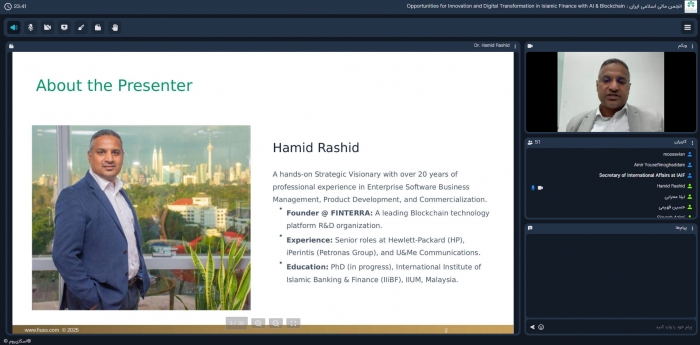
The Iranian Association of Islamic Finance held an international webinar on “Opportunities for Innovation and Digital Transformation in Islamic Finance with AI & Blockchain”, on November 17.
Speaker:
Dr. Hamid Rashid
Founder, FINTERRA, Award-winning Islamic FinTech Company
Regular Speaker, World Bank, IsDB, Securities Commissions, and Central Banks
The significant growth and innovation opportunities at the intersection of financial technology and Shariah compliance. It frames Islamic FinTech as a movement driven by technology (AI, Blockchain), adherence to Shariah principles, and an ethical framework emphasizing fairness and risk-sharing.
The presentation identifies three key drivers for this boom: a large, young, tech-savvy Muslim demographic demanding values-aligned digital products; a growing global appetite for ethical and ESG-compliant investments; and the widespread adoption of digital banking infrastructure.
The Islamic FinTech market is projected to nearly double, from $161.2 billion in 2023/24 to $305.5 billion by 2028. Saudi Arabia, Malaysia, and Indonesia are identified as the leading hubs. Despite this growth, the industry faces hurdles, primarily "Access to Capital" and "Regulatory Compliance Requirements." Key undeveloped sectors ripe for innovation include Takaful-Tech (insurance), Capital Markets, and Islamic Social Finance (Zakat-Tech and Waqf-Tech).
The presentation pivots to the core Shariah foundations, explaining that all innovation must preserve the Maqasid al-Shari'ah (objectives of Shariah). This requires prohibiting Riba (interest), Gharar (excessive uncertainty), and Maysir (speculation), and instead utilizing asset-backed contracts like Murabahah (cost-plus sale) and Mudarabah (profit-sharing).
Artificial Intelligence (AI) is presented as a revolutionary tool for this sector. Its applications include:
Shariah Compliance (RegTech): AI algorithms can provide real-time auditing to screen investments and transactions, flagging potential Riba or Gharar.
Personalization: AI-powered robo-advisors can create and manage personalized, halal-compliant investment portfolios.
Financial Inclusion: AI enables alternative credit scoring for unbanked populations, fulfilling a key ethical objective of Islamic finance.
Similarly, Blockchain technology is described as a "natural alignment" with Islamic principles. Its immutable and transparent ledger reduces Gharar (uncertainty), and its ability to "tokenize" real-world assets directly supports the Islamic requirement for asset-backed financing. Smart contracts can automatically execute Shariah-compliant agreements, such as profit distribution. A primary use case is in Social Finance, where blockchain provides unprecedented transparency for Zakat (alms) and Waqf (endowments), solving the challenge of trust by allowing donors to trace their funds to the final beneficiary.
The presentation concludes that the future of Islamic FinTech lies in Digital Assets, Capital Markets, and Social Finance. By aligning AI and Blockchain with its core ethical principles, Islamic FinTech is positioned to lead a global transformation toward a more inclusive and transparent financial system.